
Introduction
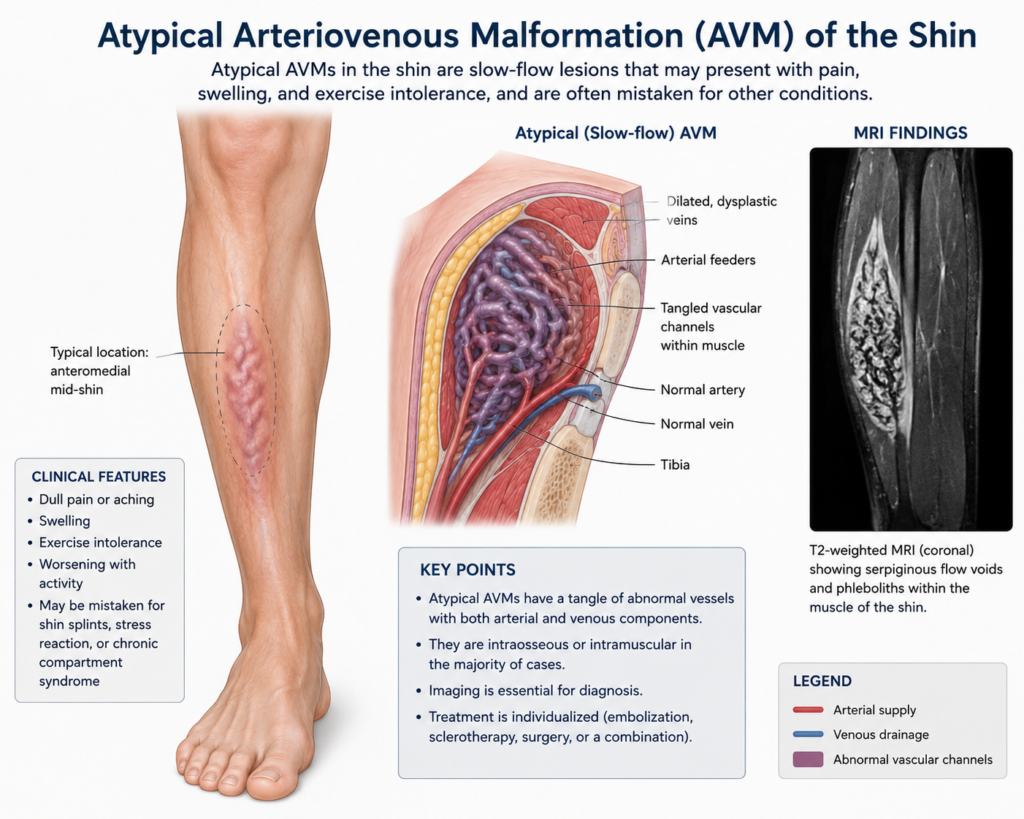
We are trained to look for the “zebras,” but clinical practice often teaches us a harder lesson: sometimes the horse has stripes that don’t quite fit. During a recent in-service training session, I was presented with a case of a middle-aged female patient with a 20-year history of right lower leg pain, eventually diagnosed as an Arteriovenous Malformation (AVM).
This case didn’t just challenge my knowledge of vascular anomalies; it forced me to reflect on my own biases regarding chronic pain, female athletes, and how we handle diagnostic uncertainty.
The Danger of the “Obvious” Diagnosis
My first reflection is on clinical momentum. For over 20 years, this patient’s symptoms were likely dismissed as exercise-related wear and tear, tendinopathy, or perhaps the residual effects of an initial DVT scare. She was a high-level aerial acrobat and competitive powerlifter. It would be incredibly easy to look at her history and say, “Of course, your leg hurts—you hang upside down by it.”
But the clue was in the pattern. Pain triggered by hanging, swelling on long-haul flights, and crucially, swelling linked to the luteal phase of her menstrual cycle. How often do we take a truly detailed gynaecological history for a lower leg complaint? This case reminded me that hormones don’t just affect the uterus; they affect vascular permeability and fluid shifts. An AVM, being a tangle of abnormal blood vessels, would be exquisitely sensitive to those cyclical changes.
The Periosteal Clue
When the MRI and X-ray revealed periosteal changes, my initial bias leaned toward stress fracture or chronic exertional compartment syndrome (especially given the aerial acrobatics). But the absence of bone tenderness and the specific location of the pain (deep into the foot flexor compartment) didn’t fit.
The reflective lesson here is about imaging literacy. An initial ultrasound missed the lesion. It was only a repeat scan and eventually vascular imaging that confirmed the AVM. How many patients have we discharged with a diagnosis of “chronic pain” because a standard MRI showed nothing dramatic? The radiologist noted oedema and periosteal change, but it took a second look to connect it to vascular structures.
The Psychological Toll of Diagnostic Delay
Perhaps the most poignant part of this case is the patient’s background as a university academic—someone trained in critical thinking—trapped in a body that medical professionals had effectively given up on for one joint while ignoring a 20-year mystery in another.
This patient wasn’t anxious or catastrophizing. She was frustrated. She presented with objective signs (swelling, sensory changes, lower limb postural findings) and a clear mechanical trigger. Yet it took two decades and a multi-modal imaging approach to find the AVM. My reflection is this: persistent investigation is not the same as doctor shopping. When a highly educated, articulate, and observant patient tells you something is wrong, our job is to keep asking “what” and “where,” not “if.”
Key Takeaways for My Practice
- Listen for the Hormonal Link. If a female patient’s limb swelling fluctuates with her cycle, think beyond musculoskeletal mechanics. Think vascular, lymphatic, or connective tissue.
- Beware the “Athlete” Bias. Just because an activity (aerial silks) is high-risk does not mean it is the sole cause of the pathology. The AVM was the substrate; the rope was just the trigger.
- Negative Scans are Not End Points. The first ultrasound was clear. The second found a significant lesion. We must be humble enough to repeat imaging or use different modalities when the clinical picture doesn’t match the report.
- Satisfaction is not a cure. The patient was relieved to finally have a diagnosis. That is a low bar after 20 years. True satisfaction will come when the specialist team offers a management plan that allows her to return to the sport she loves, safely.
Conclusion
This case, discussed during our in-service training, is a masterclass in complexity. It sits at the intersection of vascular medicine, sports physiotherapy, and endocrinology. It reminds me that a “refusal to accept normality” in the face of persistent symptoms is not a personality flaw in the patient—it is a clinical sign for the practitioner.
We often talk about “thinking outside the box.” But in this case, the box wasn’t the diagnosis; the box was our assumption that a painful leg in a powerlifter must be muscular. The AVM was there all along, quietly swelling on flights, waiting for someone to look at the blood vessels instead of just the bones.
Question for readers: Have you ever had a case where a patient’s menstrual cycle or a specific environmental trigger (like flying) was the key to unlocking a vascular diagnosis?
Reflection 1: The Weight of a “Typical” Patient Story
My first reflection was on how easily we can be misled by a patient’s history. The individual in question was highly active and engaged in demanding physical pursuits. It would have been very easy—and perhaps initially reasonable—to attribute all symptoms to overuse, mechanical irritation, or simply “part of the sport.”
But the training case highlighted a key error in that thinking: not every symptom in an active person is due to activity. Just because a patient engages in high-intensity exercise does not mean every ache, pain, or swelling originates from musculoskeletal overload. The case forced me to ask: how often do we stop investigating once we find a plausible, but incorrect, explanation?
Reflection 2: The Clues We Miss
The most striking aspect of the case was that certain patterns in the patient’s history had been documented but not connected. There were specific, reproducible triggers. Some factors changed over time, such as cyclical physiological variations. And there were subtle physical findings that had been noted but not pursued.
What I took away was this: a negative initial investigation is not a full stop. The case demonstrated that persistence—both from the patient and from different clinicians—eventually led to the correct diagnosis using a different imaging modality. As reflective practitioners, we must be comfortable saying, “I don’t know,” and then seeking another opinion or another test.
Reflection 3: The Patient’s Perspective
The patient in this case was described as articulate, educated, and highly observant of their own body. Yet for many years, they were likely told that nothing was seriously wrong. The relief at finally receiving a diagnosis was palpable, even in a case discussion.
This reminded me that diagnostic uncertainty is not neutral—it is actively distressing for patients. Our role is not just to treat, but to validate, to keep searching, and to know when to refer. A patient who keeps returning with the same story deserves our respect, not our skepticism.
Reflection 4: Systems and Referrals
The case also highlighted the importance of multidisciplinary working. No single clinician had all the answers. It took input from primary care, physiotherapy, radiology, and ultimately specialist services to conclude. The training session emphasised that timely referral and clear communication between teams can shorten years of suffering.
Key Generic Takeaways for My Practice
- Avoid the “activity bias.” Just because a patient is fit and active does not mean their symptoms are benign or overuse-related.
- Listen for patterns. Pay close attention to specific triggers, timing, and any cyclical or situational factors the patient volunteers.
- Negative tests are not final. If the clinical picture strongly suggests pathology, be prepared to repeat investigations or try different modalities.
- Validate the patient’s experience. A long history of unexplained symptoms is a burden. Acknowledging that burden is part of therapeutic care.
- Reflect as a team. In-service training exists precisely for cases like this—to help us learn from each other’s blind spots.
Final Reflection
This case did not give me a new fact to memorise. Instead, it gave me a new lens. I now listen more carefully when a patient describes a long, winding path of symptoms and negative tests. I am more willing to challenge my first assumption. And I am more grateful for colleagues who bring complex cases to in-service training, because those are the cases that change how we practice